
Hocking County Recent Arrest Sources
Hocking County handles detention regionally. The sheriff's office points anyone asking about prisoners toward the Southeastern Ohio Regional Jail, SEORJ, in Nelsonville. Five counties share the facility: Athens, Hocking, Morgan, Perry, and Vinton. SEORJ's official inmate-information page links to the JDS "New Inmate Roster." That roster is the best public window on who is currently held. It is not a Hocking-only list, though. Nor is it a timeline of every arrest. Context comes from the arresting-agency field. An entry naming Hocking County Sheriff, Logan Police, or Nelsonville Police likely involves a Hocking arrest. The same jail holds people from all five member counties. Book date and custody status are separate facts. Read the fields together, and the regional roster becomes a workable Hocking arrest tool.
| Public view | Actual window | Best use | Photo |
|---|---|---|---|
| JDS New Inmate Roster | Current regional custody | Confirm a person is held at SEORJ | Shown where available |
| Daily Arrest Report | No official 24-hour filter | Read run time and recent book dates | Routes to official roster |
| Weekly Arrest Log | No official multi-day blotter | Use agency logs, records, courts, and careful news checks | Varies |
For same-day results, the Daily Arrest Report covers that narrow window. The Weekly Arrest Log handles the wider view.
Search Hocking County Arrest Custody
Begin at the SEORJ inmate-information page and follow its official link to the JDS regional roster. The roster divides into male and female sections. There is no Hocking-only search form. Browser find can pull up a name quickly. A match still needs context, so check the arresting agency and book date before calling it a Hocking arrest.
| Roster field | How to read it |
|---|---|
| Run Date/Time | When that roster copy was generated, not when each arrest happened |
| Jail ID and name | Facility identifier and displayed name; compare carefully |
| Photo | Booking image when the public row supplies one |
| Charges | Charges as recorded by the facility, often in shorthand |
| Disposition and bail | Custody fields that do not replace a final judgment |
| Book Date | Intake date, which may be earlier than the roster run |
| Arresting Agency | Key field for separating Hocking agencies from other counties |
| Court and next date | May be blank; confirm through the court |
Use this order when checking a booking:
- Open the roster through SEORJ’s official page and note its run date and time.
- Find the name, then compare book date, arresting agency, and jail ID. Do not rely on facility location alone.
- Read charge and bail lines as intake data, not findings of guilt.
- If the name is missing, call SEORJ at 740-753-4060 for current prisoner guidance.
- Ask the arresting agency for its report and use the court docket for the outcome.
The official-linked JDS roster shows its regional heading and run stamp:
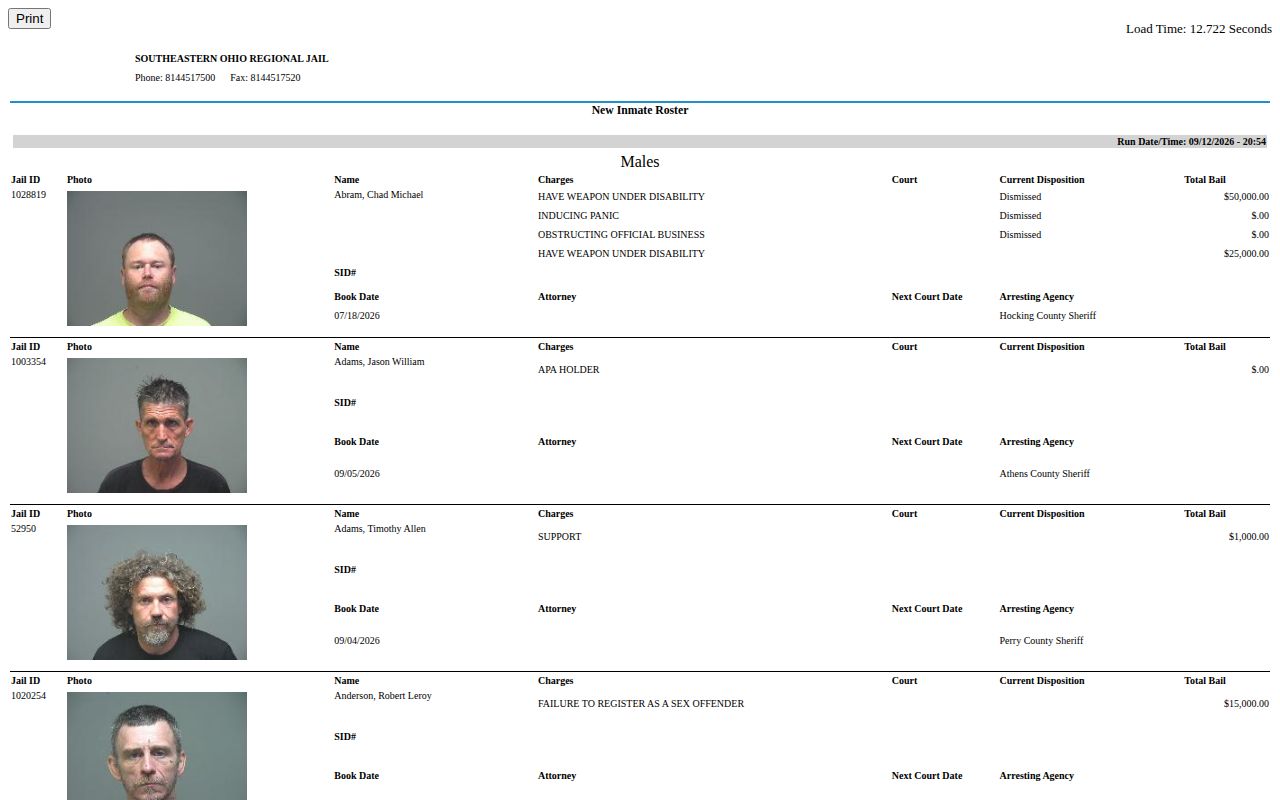
The SEORJ page displays the roster interface itself, not a gallery of booking photos.
Where Hocking Arrest Records Appear
Every arrest leaves a paper trail split across offices. The arresting agency keeps its incident report. SEORJ holds intake and custody data. Hocking Municipal Court or Common Pleas Court records the case and its outcome, Ohio VINE adds alerts, and ODRC covers any later state custody.
| Channel | Official? | Coverage | Photo? |
|---|---|---|---|
| HCSO or city police | Yes | Originating report or agency log | Request dependent |
| SEORJ/JDS roster | Yes, linked by SEORJ | Current regional custody | Often |
| Hocking courts | Yes | Filed charges and case result | No booking-photo role |
| ODRC Offender Search | Yes | State custody or listed supervision | Detail views may show one |
| Local news | No | Selected events, not a complete log | Story dependent |
| Commercial archives | No | Copied, possibly stale material | Often |
Third-party arrest sites come second to official sources. BustedNewspaper and Mugshots.zone file entries under the regional jail, so several counties mix together. Mugshots.com keeps a stale Hocking section. RecentlyBooked's Ohio county list includes no Hocking entry at all. Arrests.org offers date navigation yet is not an official archive. Treat all of these as leads, then confirm details with the agency, roster, or court.
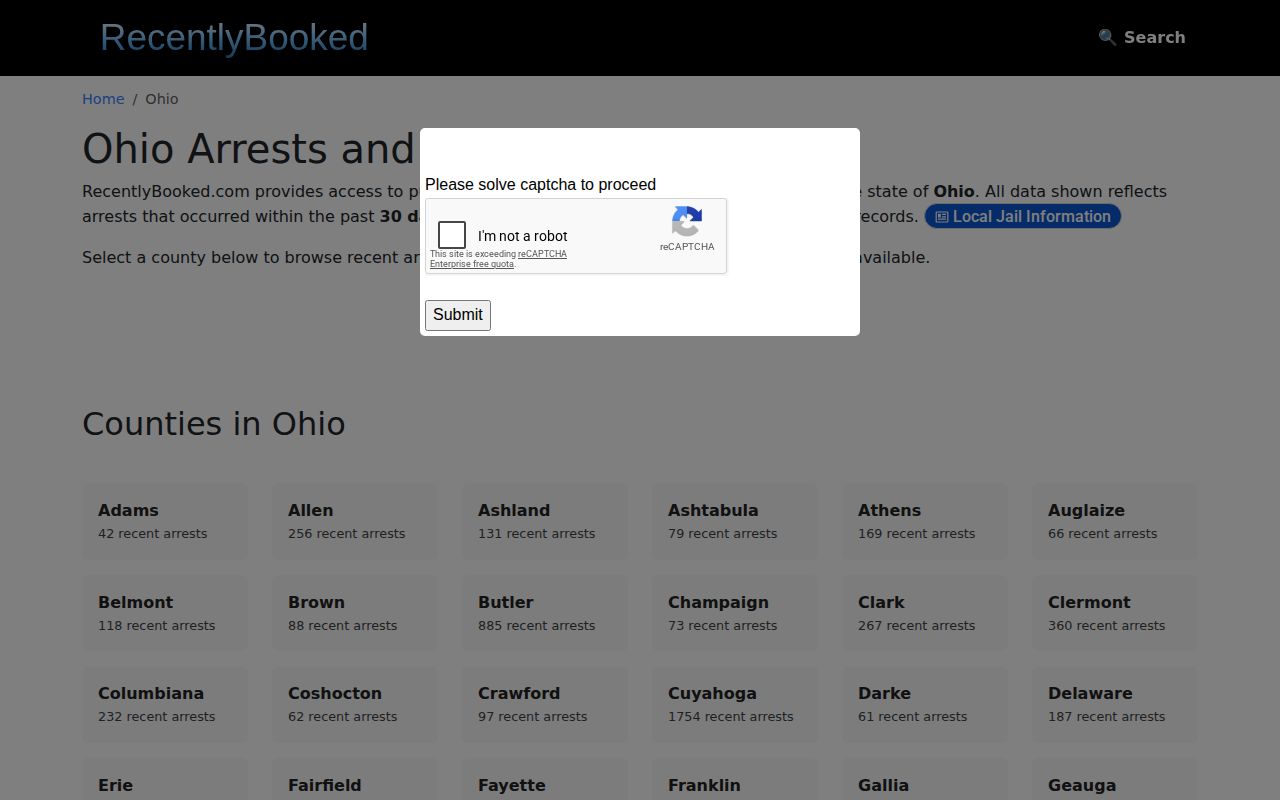
This unofficial snapshot can change and does not replace an agency or jail response.
Recent Arrests Across Hocking Cities
Where someone was arrested determines the agency, even if most adults end up at the same regional jail. Logan runs its own police department. Nelsonville has municipal police and hosts SEORJ itself. Laurelville has no standalone force, so the Hocking County Sheriff's Office patrols it under contract. That is why the arresting-agency field matters so much.
- Logan Recent Arrests covers Logan Police records, its daily information log route, and SEORJ custody.
- Nelsonville Recent Arrests separates a city arrest from being housed at the regional jail in Nelsonville.
- Laurelville Recent Arrests follows the HCSO contract-patrol and regional booking path.
A person housed in Nelsonville was not necessarily arrested there. A Logan or Laurelville arrest may reach the shared roster only after transport and intake. Place, agency, and facility are three different facts.
Hocking County Arrest Record Fields
A booking record is just one layer. The agency report covers the initial action. SEORJ logs intake and custody, while the court supplies the legal result. Comparing layers prevents the common mistake of reading a roster label as the full court history.
| Field | Meaning |
|---|---|
| Name and jail ID | Displayed identity and facility reference |
| Booking photograph | Custody image, not evidence of guilt |
| Book date | Date of facility intake |
| Charges | Accusations recorded during booking |
| Total bail | Roster value needing court and custody context |
| Arresting agency | Office associated with the arrest |
| Court and next date | Scheduling leads that may be blank or change |
| Current disposition | Facility field, not always a final judgment |
- Booking
- The jail intake process, including identity, charges, property, and a photo where taken.
- Arraignment
- The first court stage at which charges are stated and release conditions may be addressed.
- Bond
- A court-set condition tied to release; it is not a penalty or conviction.
- Disposition
- The outcome of a case or charge, such as dismissal, plea, or judgment.
- Expungement
- A statutory process that can destroy, delete, or erase qualifying official records under court order.
Hocking County Mugshots and Arrest Photos
The JDS roster shows a booking photo where available. That image belongs to a live custody record and can vanish when the row changes or the person leaves. HCSO publishes no separate Hocking mugshot gallery. None is reproduced here either. If a photo is missing, gather the agency, book date, and jail ID, then ask that office or SEORJ about a releasable copy. The ODRC Offender Search does a different job. It tracks state prison and certain supervision statuses, not a fresh local booking. A detail page can include an offender photo, offenses, committing county, sentence, institution, and release information. Committing county is not arrest location. Never swap an ODRC photo for a recent SEORJ image without matching the records. Ohio Revised Code §2927.22 governs covered booking photographs and criminal-record information. The law targets paid removal. It bars negligently soliciting or accepting payment from the subject for removal, correction, modification, or nonpublication. That is its focus, not a broad erasure right. Sealing or expungement starts with the court.
Request Hocking County Arrest Records
Hocking County arrest records sit at the sheriff's office. The HCSO public records policy opens its counter on weekdays from 8:00 a.m. to 4:00 p.m., county holidays excluded, and an online email form covers the same ground. Ohio Revised Code §149.43 governs each request. Production is supposed to be prompt, though review, redaction, and legal consultation can stretch the timing. Describe the record in enough detail to identify it.
- Name the record series, such as an arrest report, incident report, dispatch log, or booking photograph.
- Give a focused date range, report number, name, or address when known. Do not ask the office to create a new database.
- Identify the originating agency. HCSO, Logan Police, Nelsonville Police, SEORJ, and courts hold different parts.
- Ask which retention schedule applies and whether any part is exempt or redacted.
- Use the court docket to confirm a dismissal, plea, conviction, sealing order, or expungement order.
Copies carry set fees. Ten cents buys a page of recorded documents. A CD runs four dollars. Video reproduction costs seventy-five dollars per hour with a seven-hundred-fifty-dollar cap. Delivery charges may apply, so confirm the total before ordering. The policy offers a five-day estimate where practical. That is no hard deadline for every request. The posted HCSO policy lays out office hours, response language, and fee terms:
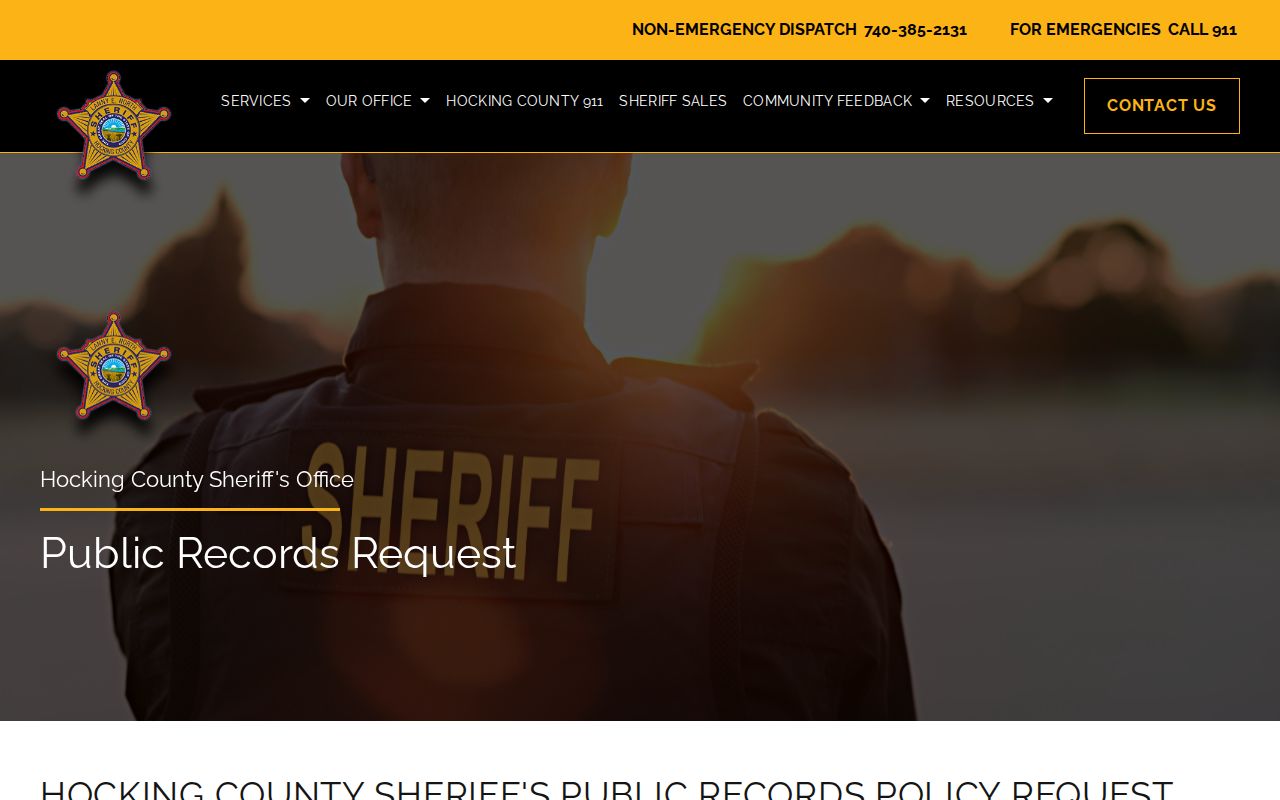
The live policy controls if its wording or amounts change after this capture.
Ohio Arrest Law and Removal
Ohio's Public Records Act, ORC §149.43, grants inspection and copying rights. Exemptions, redaction, retention, and response time all shape the release. Nothing requires an office to build a new list. Juvenile, victim, medical, protected-address, and sealed information may be withheld. Ask for an existing record.
Adult sealing and expungement run through Ohio Revised Code §§2953.32 through 2953.34. Eligibility turns on the case. Hocking courts post local filing guidance, and legal questions belong with counsel or the clerk. Once relief is granted, send the order to each official holder it reaches. Unofficial publishers have free correction processes.
Never pay a publisher to remove covered Ohio criminal-record information. Section 2927.22 targets that trade. A third-party update never changes the court file. Correct the source first. If a stale search-engine snippet lingers afterward, use the engine's outdated-content process.
Retention is record-specific. In Ogle v. Hocking County Sheriff, the appellate court weighed HCSO records that no longer existed under an approved retention schedule, and it held the office need not create a date-and-time index it never kept. No permanent Hocking arrest archive can be promised. The statute on an order's effect spells out instructions and legal consequences:
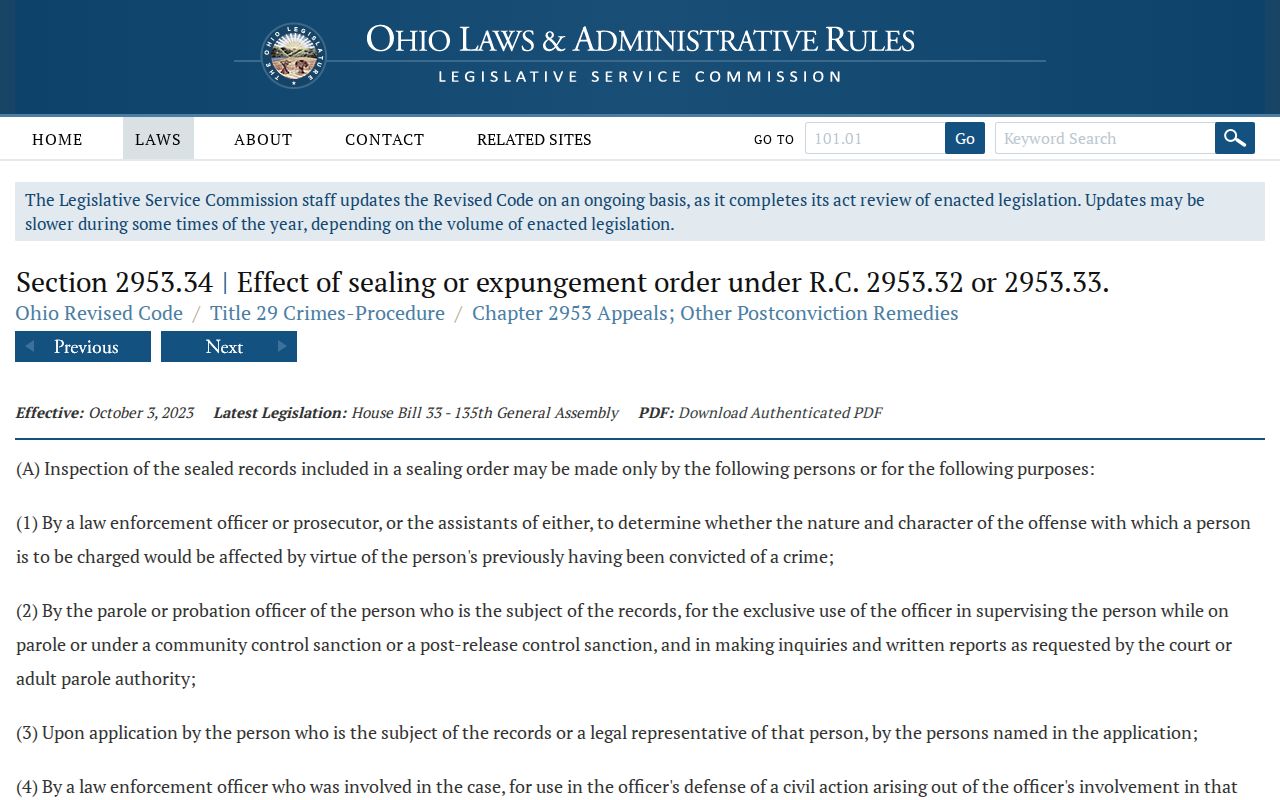
A court order, not a private publisher’s policy, controls the official record.
Hocking County Arrest Warrants
Hocking County has no online warrant search of its own. HCSO runs a Warrants, Extradition and Prisoner Transport Division. Chris Johnson answers at 740-385-2131, extension 4203. The Municipal Court's general information page sets the local rule. Anyone holding a Municipal Court warrant must turn themselves in during normal business hours. No hearing gets scheduled while the warrant stands. Check status through the court clerk, HCSO warrants staff, or an attorney. Never approach or detain a wanted person yourself. Send urgent safety tips to 911 and routine information to the agency. A warrant can precede an arrest. It may mark a missed court date or tie to community control. It is not a new booking charge.
After a Hocking County Arrest
Misdemeanor and traffic cases go to Municipal Court. Felonies move through Common Pleas and the Clerk of Courts. The Municipal Court takes record searches by website, email, or fax. Arraignments generally land on Wednesday mornings, though video logistics and judicial schedules can shift them. A jail roster and a court calendar may update at different times. The Clerk of Courts offers Internet Inquiry. It covers felony criminal and other listed cases. Online coverage for those categories starts in 1996. Older or missing material requires a clerk request. Court entries supply the ending a booking row cannot. They show filed charges, plea, dismissal, judgment, sentence, and later sealing. The path runs from an arresting agency's report to SEORJ booking and a possible photo. From there come the current roster, arraignment, and court disposition. Sealing or expungement may follow when the law allows. Each stage can take time.
Hocking Arrest Alerts and Apps
Hocking County's official sheriff app handles tips, crime reports, and public-safety news. Its description promises no roster or booking-photo search. It is an outreach tool, not an emergency channel. Smart911 covers broader emergency alerts, not custody tracking.
For one person's custody status, the county prosecutor points to Ohio VINE and SEORJ. The VINELink Inmate Check walks through searching and registering for release or transfer alerts. Alerts can lag. Make a direct call when you need immediate confirmation. The official app listing describes its tips and public-information role:
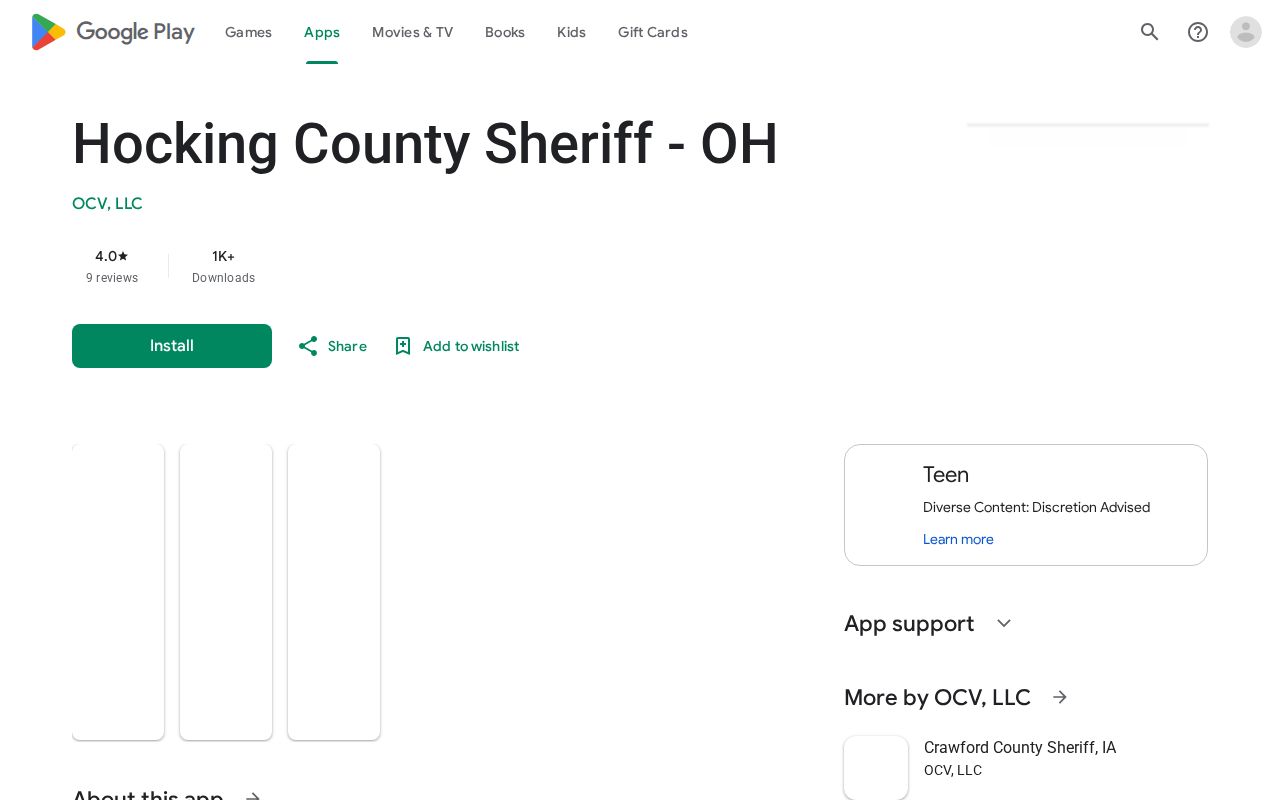
The listing does not represent the app as a comprehensive booking or custody database.
Verify Each Hocking Arrest Stage
A solid check follows the record through its life. Start with the agency. Confirm who made the arrest or wrote the citation. Then learn whether the person finished intake at SEORJ and is still housed there. Next, find the court handling the case. Last, watch for any transfer to ODRC or federal custody. These stages are not interchangeable. A police report can exist before a jail row shows up, and a court filing can remain long after the name leaves the roster.
Timing causes many apparent conflicts. Transport, medical clearance, identity checks, and data entry all happen at different points, and so do release and roster generation. The public JDS page carries a run stamp. SEORJ promises no fixed delay from arrest to publication. An older book date on the roster can simply mean the person is still held. Someone booked and released fast may never show up when you check. For live custody, call the jail; for the original event, ask the agency; for the legal result, use the court.
Which source controls after release? The live roster answers present custody only. Once a row disappears, the arresting agency may still hold its report, SEORJ may keep intake records, and the court may keep a case file. Ohio retention rules differ by record series, so state exactly what you need and ask the custodian which schedule applies.
Hocking Records Beyond Local Custody
Custody does not always stay local. A person sentenced to Ohio state prison, or held under a listed ODRC status, may appear in the state offender search. Federal Bureau of Prisons custody belongs in the BOP Inmate Locator, which publishes no booking photos. Current ICE or CBP detention uses the ICE Online Detainee Locator. None replaces a fresh SEORJ check.
Each system marks a different custody state. A person may be just booked, held locally, released, or moved into state or federal hands. Names drop off the regional roster all the time. Confirm release or transfer through SEORJ, VINE, the court, or the receiving system before drawing conclusions. A missing row never means the arrest was erased.
Hocking County Sheriff’s Office Location and Directions
Search Public Records
Sponsored Results